


 Explore the Royal Palace




Monica Biancardi
The beauty photographed by Monica Biancardi is the one that reveals itself in the places that breath of ancient memories, beauty that appears in its poetic spontaneity to the gaze of those who are used to feeling places even before seeing them.
Artist bio
Monica Biancardi was born in Naples in 1972. After a degree in stage designing at the Academy of Fine Arts in Naples, she started to work with important Italian and foreign stage directors, as a teacher and at the same time she pursued a personal photography research based on identity, memory, migration, intercultural dialogue and female condition. Her first research “Credere” consists in twenty years of white and black photoshoots in the South of Italy, the work has been partially purchased together with other works by the Bibliothèque Nationale de France and in 2014 it was exhibited in the official program of the Mois de la Photo in Paris. In 2003 her first exhibition “Ritratti” was opened in Naples and later exhibited at Macba of Barcellona, in Madrid, in Salamanca, at Brescia Biennale of Photography at MADRE Museum of Naples. Achille Bonito Oliva who invited her to design a whole cell in the Chartreuse of Padula, during the review “Le Opere e i giorni”. “Dolore”, that is part of the artistic project “Aldilà”, was acquired by the new Naples metro and installed at the metro stop Lala. In 2004 invited in Catania by Antonio Presti she made the storytelling “Viaggio a Librino” with the Israeli writer Mejr Shalev. In 2005 she created “Un Abbraccio per la pace”, a performance in Milan, in Piazza Castello, that was performed again in Naples Piazza Dante and in Jerusalem on Mount of Olives with Arab and Israeli women. In December 2006 in at Castel Sant’Elmo in Naples she exhibited “Mutamenti”, dedicated to her father (catalogue Electa editions) that later was exhibited in Milan and at Arau in Switzerland. Sensitive to the theme of cultural integration, Monica Biancardi exhibited a work she had been carrying out for years in Palestine (cat. Al Quds University) on behalf of Al Quds University of Jerusalem. The project was later exhibited in its multimedia version “Tra le immagini” at the MAV of Ercolano. In 2009, within a project on cultural contamination, , on invitation of the Superintendence of Naples and contemporaneously with Julian Schnabel and Luigi Ontani, she exhibited in “Orientamenti” at the Museum of Capodimonte in Naples (catalogue ed. Shin Art). In October 2012 the MART of Rovereto invited her to exhibit the project “Habitus”. From 2013 to 2015 she was the artist selected for Premio Napoli Foundation One of the portraits from “Ritratti” won the Serrone Prize, at Villa Reale in Monza. In 2015 she won the prize Dolomiti Arte Contemporanea. In 2017 Monica Biancardi published for the publishing house Damiani “RiMembra”, a project lasted more than seven years in collaboration with the poet Gabriele Frasca. The work was exhibited at Nitsch Museum in Naples, at I.I.C. in Paris during Paris-Photo, at the Museum of Santa Maria della Scala in Siena and in May 2018 it was selected for Aubagne Biennial Exhibition of Photograpy.. In October 2018 the publishing house Contrasto published the book “Manodopera”. In February 2019 she exhibited at Shazar Gallery in Naples part of the project “Punti di Vista”, started in2016 and still in progress, whose polyptych “Finis Terrae” was purchased by the MADRE of Naples. In 2020 she started “The catalogue of huts”, that is the snapshot of what had happened to the women who had lived within the family during the lock- down. It was exhibited in 2001 at the Nuvola in Rome. She teaches Design and History of Costume in the Secondary School and Photography at the Academy of Fine Arts. Her works are in many private and public contemporary art collections.

 Travel notes
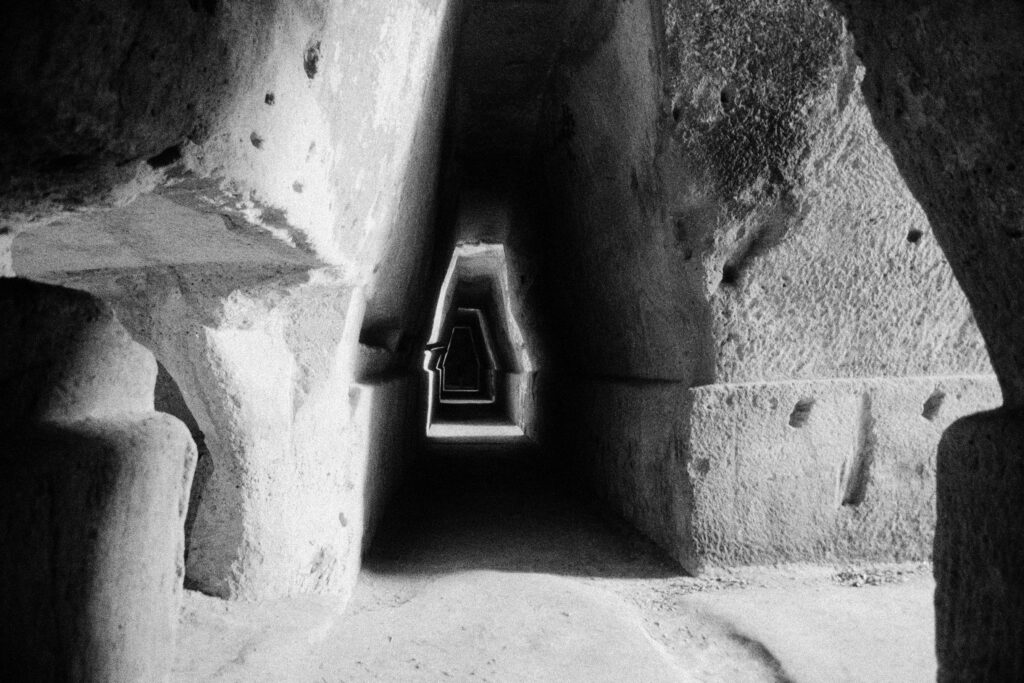
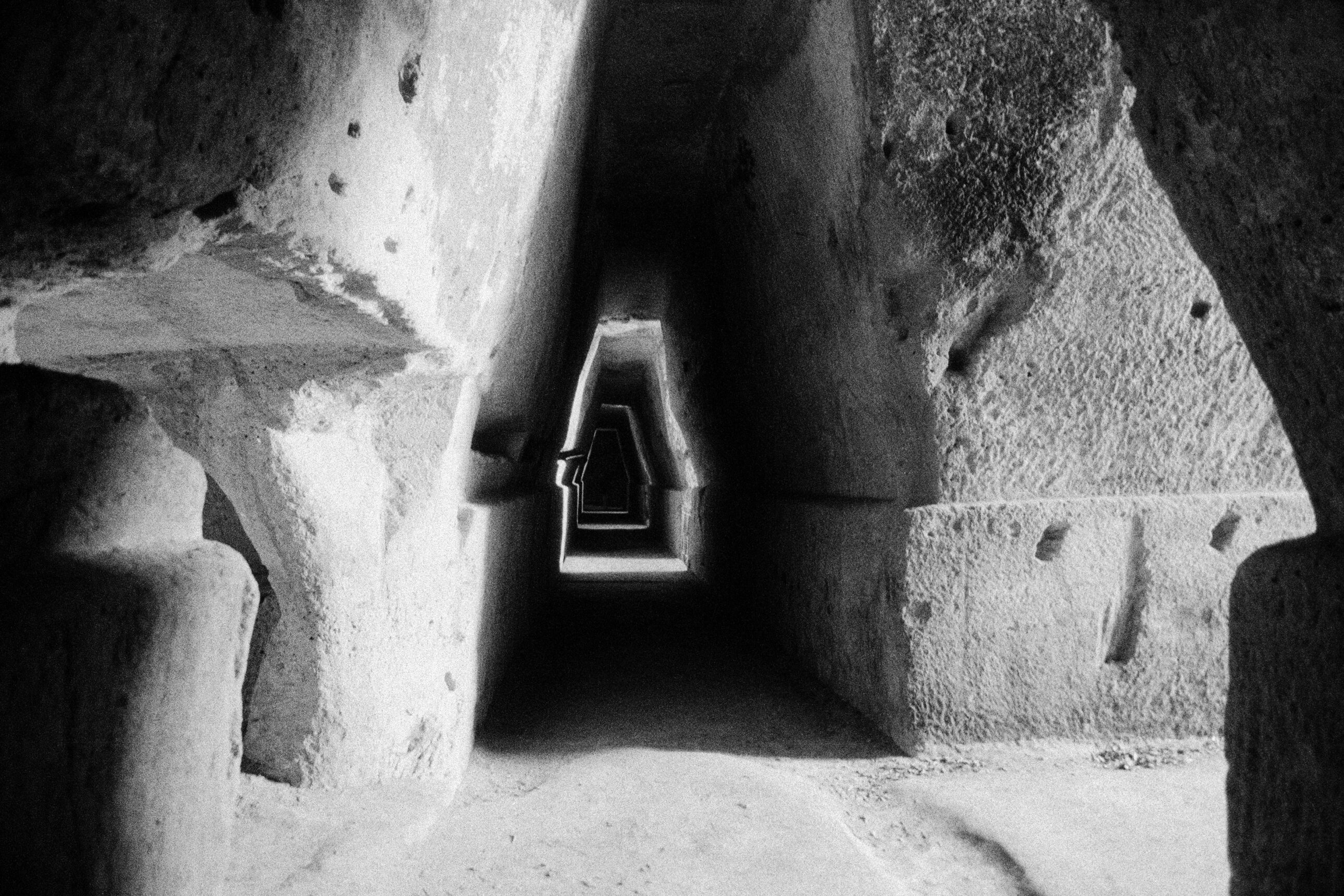
The Cavern of the Sybil, Cuma - Naples
One of the most charming sites in the Plegraean Fields, it is an artificial gallery of the 7th century B.C. with a trapezoidal section entirely carved in the tuff dating back to the Greek-Roman Naples. The trapezoidal shape was a Greek antiseismic technique. The cavern is 131mt long and ends with a hall characterised by a flat vault with three niches. Probably it was a military construction used by the Romans to defend the city and its harbour. In the Roman Age it underwent different transformations, in fact it was also used as a burial site until the abandonment of the ancient town of Cuma. Like the oracle of Delphi, the Cumaean Sibyl was one of Apollo’s priestesses with oracular functions: she used to perform her holy rituals and give her responses to mankind also by taking advantage from the suggestive quality of the cavern acoustic.
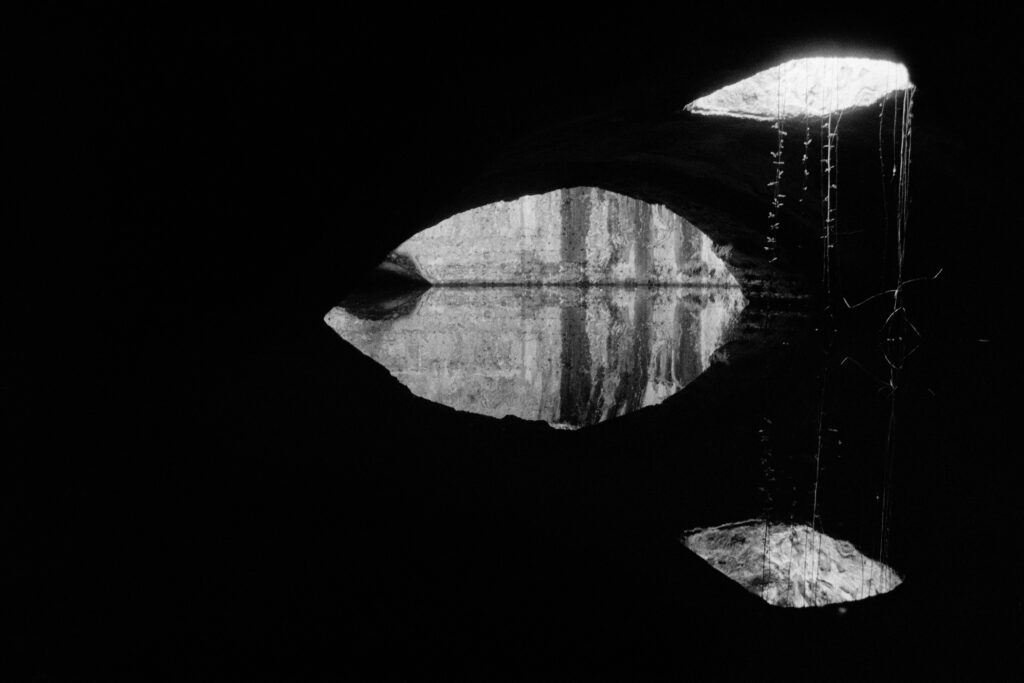
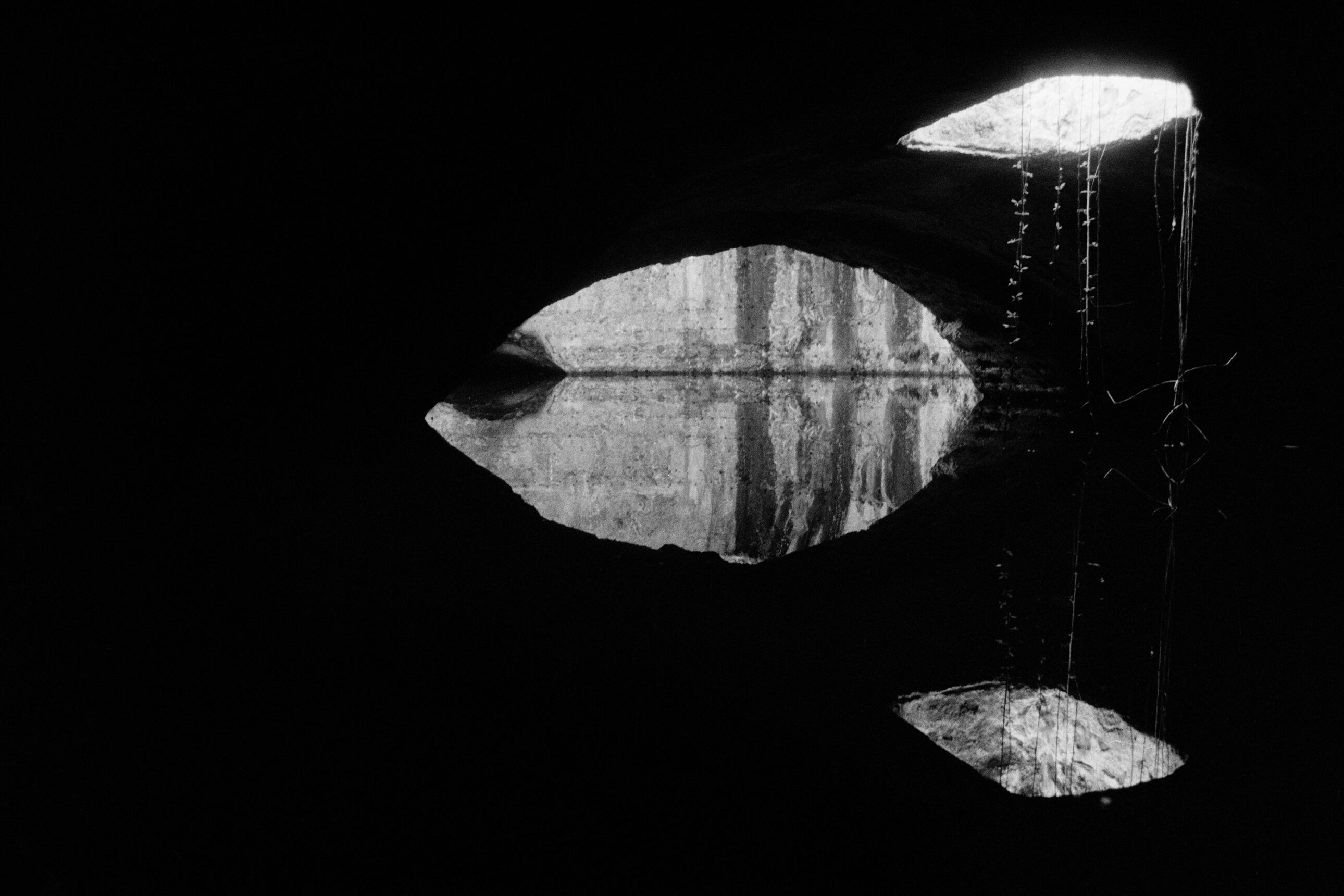
Temple of Mercure, Baia - Naples
It is located in the archaeological area of Baia in the territory of the Phlegraean Fields (from Greek ‘burning land’ because of the phenomenon of bradyseism of the volcanic area) Baia is known as the “Roman Atlantis” thanks to its precious finds that are in good state of conservation. For that the archaeological Underwater Park of Baia is one of the world’s few underwater archeological parks and a unique example in the Mediterranean environment of archaeological and naturalist underwater protection. In the Roman times the ancient town of Baia, today submerged, was the most famous commercial place in the 2nd century B.C. it was also famous for its thermal waters and as holiday resort. Despite its name, the Temple of Mercure had no sacral functions. It was a place used as a Frigidarium, which is a thermal pool for cold baths (while Calidarium was the part of the thermal baths where having warm baths). The “temple is part of a thermal complex which also includes the Temple of Diana and the Temple of Venus. It is circular and shows a central “lumem” (a light flow), that anticipates the one in the Pantheon, but of smaller dimensions.
